How Much Deposit Should a Contractor Ask For?
Most advice about deposits tells you to ask for 30 to 50 percent upfront. In several states, that advice will get you cited.
Here is what is actually normal, what is actually legal, and how to say it without losing the job.
The number, and the number that matters more
Ten to thirty percent is the working range for a deposit on residential work, and one third is the usual ceiling. Anything at or above half upfront reads as a red flag to homeowners, because that is exactly the pattern the deposit laws were written to stop.
But the deposit is only milestone zero. What experienced contractors actually run is a schedule:
- Deposit at signing to hold the dates and order materials
- A progress payment at a visible milestone, rough-in or first day on site
- The balance on completion
That structure protects you better than a big deposit does, because you are never more than one stage ahead of the money.
Check your state before you set your terms
This is the part almost nobody tells you. At least nine states cap deposits by law, including Arizona, California, Indiana, Maine, Maryland, Massachusetts, Nevada, Pennsylvania and Tennessee, and among those the most common ceiling is one third of the contract price.
California is the strictest in the country. Business and Professions Code 7159 caps home improvement deposits at 10 percent of the contract price or $1,000, whichever is less. On a $30,000 kitchen, the legal maximum deposit is $1,000, not $3,000. There is no exception for special order materials, and violations can bring license discipline.
Maryland caps at one third. On a $20,000 project that is about $6,667, and you cannot take any payment before the contract is signed.
Nevada caps at 10 percent or the cost of special order materials, unless you post a bond.
Texas, Arizona and New York have no statutory cap, so the contract governs, and consumer protection law still applies.
The practical rule: search your state or province plus "contractor deposit law" before you write your standard terms. It takes five minutes and it is the cheapest legal advice you will ever get. This is general information, not legal advice, and the rules change.
If you work in a capped state, structure around it legally. Small deposit at signing, then a substantial first progress payment due on the day work starts or when materials are delivered. Compliant, and the money still moves before you are deep into the job.
How to word it without losing the job
Put it on the estimate, not in a phone call. A number in writing is a policy. A number spoken is a negotiation.
Deposit of 20 percent to book the dates. 40 percent at rough-in. Balance on completion. Materials are ordered once the deposit clears.
That last sentence does most of the work. You are not asking for money because you want it, you are explaining that the job starts when the material order does. Nobody argues with a supplier.
If a client pushes back, the honest answer is short: "The deposit covers materials and holds your spot on the calendar. If that does not work, I can order materials the week we start instead, and the dates move to whatever is open then." You did not lower the number, you offered a real trade.
Getting paid without chasing
The deposit is the easy money. The last payment is where contractors lose sleep.
Put a due date on every invoice, not "due on receipt." A date gets paid faster because it removes a decision.
Invoice the same day you finish, while the work is fresh and she is happy with it.
Make paying take one tap. A link beats a bank transfer, and both beat waiting for a cheque.
And never let the last payment be the biggest surprise. If she saw 20, 40, 40 written on the estimate in week one, the final invoice is a formality rather than a negotiation.
For the wording of the rest of the document, the painting estimate guide has a full itemized example, and this one explains why the word at the top of the page changes what you can charge.
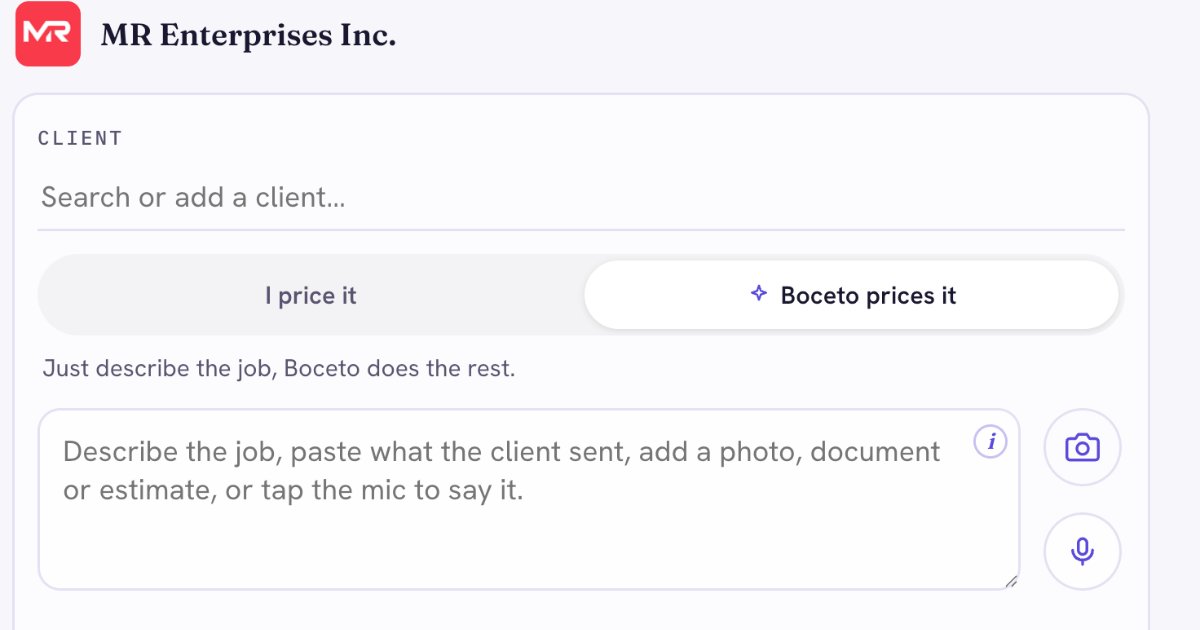
Boceto puts your deposit terms on every estimate and turns it into the invoice when the job is done, with a payment link built in. Free to try on your next job.
About Boceto
Boceto turns what you say into a professional estimate in seconds, in English or Spanish, and sends it by WhatsApp, email or text. Built for the people who do the work, not for an office.
Start freeAlso on the blog
How Long Does a Contractor Estimate Take? Real TimelinesSmall jobs: same day or next. After a site visit: 2 to 3 days. Waiting on supplier pricing: up to a week. When to follow up, and when to move on.Painting Labor Rates 2026: How Much to Charge Per Hour
Your wage is not your rate. The formula painters use (labor, overhead, profit) with real 2026 market ranges and a worked example you can copy.Best Invoice App for Contractors (2026): 11 Ranked
A tier list for solo tradespeople and small crews. Real prices, honest weaknesses, and where each app fits. Boceto included, and where it loses